


By Mary Spearman and Raen Parker Washington
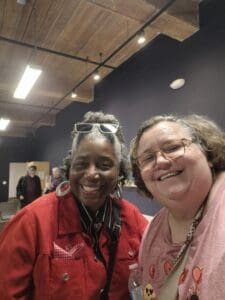
On Valentine’s Day, my friend Raen Parker Washington and I attended a poetry workshop that left me inspired and reflective. The guest facilitator was North Carolina Poet Laureate Jaki Shelton Green. This event was hosted by the Poetry Society of South Carolina.
Jaki Shelton Green was the main speaker for the event. It was well attended, and the Poetry Society hosted it beautifully. The Greenville Creative Arts Center, in its mission statement, states that it strives to, “connect artists from all stages and backgrounds.” I found this to be true of this venue and the group gathered to listen to Jaki Shelton Green. We were an eclectic group from all ages and backgrounds, which led to lively discussions and unique perspectives. I hope to attend more events at this location in the future. If you are not familiar with the Greenville Center for the Creative Arts, check out their website. Greenville Center for the Creative Arts
From her website: Jaki Shelton Green’s biography is lengthy and impressive. “Jaki Shelton Green, ninth Poet Laureate of North Carolina, is the first African American and third woman to be appointed as the North Carolina Poet Laureate. Jaki Shelton Green teaches Documentary Poetry at Duke University Center for Documentary Studies and was appointed the 2021 Frank B. Hanes Writer-in-Residence at UNC Chapel Hill. Her many awards and honors include the North Carolina Award for Literature and induction into the NC Literary Hall of Fame. See her website for more Jaki Shelton Green Awards. A few of her publications include Dead on Arrival, Masks, Dead on Arrival and New Poems, Conjure Blues, singing a tree into dance, breath of the song, published by Blair Publishers. Additionally, Jaki Shelton Green is the owner of SistaWRITE, which provides writing retreats for women writers in Sedona Arizona, Martha’s Vineyard, Ocracoke North Carolina, Northern Morocco, and Tullamore Ireland.” She also has several videos on YouTube that bring her work to the screen.
On this Valentine’s Day, and also in celebration of Black History Month, poets from the upstate sat around the table and listened to her tell how using documents, or primary sources, for inspiration helps create meaningful poems. She encouraged each of us to think about objects or articles that we may have saved from our lives and express why we saved them by writing a poem. We came from all sorts of backgrounds, but we were all gathered to learn more about this wonderful lady and her process for writing. As writers, we often learn from one another, and Jaki Shelton Green is a master teacher. After the workshop portion, she gave a reading of a few of her poems selected for the event.
When talking about documents or primary sources from the past or history, Jaki Shelton Green said, “What we keep, keeps us”. She told her own deeply personal family story and shared how they had a special nail that they have passed from generation to generation. This nail went way back to the days of slavery and had much heartbreak and sadness attached to it. A relic of great meaning to Jaki Shelton Green and her family. She showed us how to take that heartbreak and express it on the page. Documentary poetry uses primary sources to retell a historical or personal event. I found Jaki Shelton Green to be a deep and profound poet. She connects with life and its hardships through poetry.
Our host for this event was the Greenville, SC Poet Laureate Glennis Redmond. I recently bought a book by Glennis at a book event in Traveler’s Rest, SC. Her book, the Song of Everything, A Poet’s Exploration of South Carolina’s State Parks, is a beautiful look at discovering nature and beauty, which is available to all through our parks. In her remarks, Glennis Redmond said, “poetry is for everyone,” and I love that. As a novice poet myself, I find that when I do write poems, it is often my way of remembering or connecting with an event or nature. To learn more about Glennis Redmond please check out her website or this page Glennis Redmond .
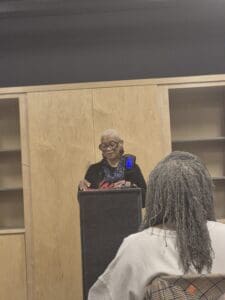
From the workshop, we each left with the beginnings of a new story or poem to work on. This workshop opened our thoughts to some unique perspectives and stories shared by other poets about their own documents saved or treasured over time. Raen Parker Washington’s key takeaway was “What we keep keeps us” names a practice in which objects, places, and rituals preserve identity, memory, and community across time. Jaki Shelton Green uses this phrase to show how family artifacts and home places become living repositories of history and belonging. Her workshop helped me consider more ways to preserve and shape who we are and who we become. It pushed me to examine my reasons for protecting family history even when others question its importance. Since the workshop I have wondered how to keep moving toward and inside of these “human museums.” It’s incredible how: small things do the heavy lifting of remembering. Lastly, I have also felt the sadness of knowing that if we do not curate our ancestors’ lives, then who will.
As a collector of things, I have had to scale back on what I take in and keep, because you only have so much room, but this workshop has made me think on a whole different level about how there are stories that could be connected to the things I keep. Each person at the workshop treasured different items for different reasons. Writing a poem focused on items or memorabilia from the past can help you remember. If those memories are painful, it may be a way to say goodbye or put the bad thoughts to rest.
Objects sometimes tell stories. Photographs may help us to remember, or there could be an old necklace that has a special significance. Before closing this article, I reflected on the things I have saved and the stories they carry. I realize now it is more about the stories than the objects themselves. Keeping objects is just a way of remembering, the real treasure is in the poem or story.
Our assignment in the workshop was to think about something that we have saved for sentimental reasons and then write a poem or the beginnings of a poem about that object. I thought about my thrift store buffet that houses my pictures and objects of sentimental importance. We were asked to write from the point of view of the object we saved and were going to hand down one day to the next generation. I had rescued this piece from a thrift store one spring and worked all day sanding and painting it with the latest white chalk paint. There are seven drawers in this cabinet. Each one has been filled with pictures, funeral programs, and small objects. Even a beloved pet’s paw was cast into plaster after he passed. I decided I would write my poem from the point of view of the buffet.
The Buffet
By
Mary Spearman
The lady rescued me from the thrift store.
I was abandoned,
scratched,
forgotten no more.
My seven drawers, all empty and hollow.
Even the top three,
lined in burgundy velvet.
The first day spent on the porch,
warmed by the sun,
my new coat of white chalk paint dried.
My excitement,
growing as I change.
New knobs,
like jewels,
adorned my doors and drawers.
Then, my new home–
a focal point.
I am a place for treasures,
memories,
and trinkets.
My job:
to protect and hold.
Decorated like a wedding cake,
with special filling.
My drawers,
filled with pictures,
treasures,
tokens.
They are safe with me,
all together now.
I wait for someone to open and look.
Each item, a moment in time, beckons.
So come open me up.
You will find stories tucked in each drawer,
waiting for you to explore,
and finding the treasure within.
Raen Parker Washington, fellow Foothills Writers Guild Member who also attended the workshop shares her poem below.
I share space on a family sideboard with pictures, jewelry boxes, scarves, and ancestral artifacts. A room arranged like a small altar of hearth, hands and names to say aloud.
I am the little red top with red and white wrap roller that remembers her mornings—Original Fresh Spice of nutmeg, clove, and love—the hush before she descends wooden stairs in a DC brownstone. Turn me once now and I speak her name to a granddaughter and the house leans in to listen: Grandma.
Turn me and I unfurl spices like a secret joy; the room remembers the cadence of name-calling of grands. And the underarms of freshly washed brown arms: hers and theirs! I have been rolled across wrists that smoothed scarves and full slips; I know the map of her palms. I know my power is her secret Grandma wand.
I hold the small choreography of leaving. When I speak, sounds of cousins dance, the Bible opens, and an antique chair remembers the shape of our lives.
I am not perfume for strangers; I am the voice that says you belong here. I am the spice that stitches present to past, the small thing that keeps her near: Grandma.
Poetry, as Audre Lorde memorably stated, “is a vital necessity of our existence. It forms the quality of light within which we can predicate our hopes and dreams toward survival and change”.