



BY: Donna Andrews Bratcher
Conductor Newton Whitner LaFoy picked up his lantern and stepped out of the baggage car as the train slowly came to a stop. The screech of its brakes pierced the dark night, and he pulled his hat down a little lower to shield himself from the rain. Even above the din of the storm, he could hear the roar of Broadaway Creek in the distance as he cautiously approached the trestle that spanned its angry waters.

Earlier in the afternoon, LaFoy and a crew of 4 other men had received an assignment to deliver a passenger car from the city of Anderson to the nearby town of Belton. The train left Anderson a short time later with Jack Wilson manning the engine car, accompanied fireman Allen Johnson and wood-passer Henry Thompson. LaFoy had joined his friend and coworker, Jefferson Kitsinger, in the baggage car. The passenger car had brought up the rear.
Recent days of constant rain had caused local creeks and rivers to rise to dangerous levels. Because of the flooding and swiftly flowing water, several bridges and train trestles had been closed or washed away completely. When the train had approached the Broadaway Creek Trestle just before dark, Engineer Jack Wilson had brought the train to a stop so that Conductor LaFoy could check the safety of the trestle before crossing. LaFoy had walked out on the trestle, assessed it in the dimming light of day, pronounced it secure, and the train had crossed safely.

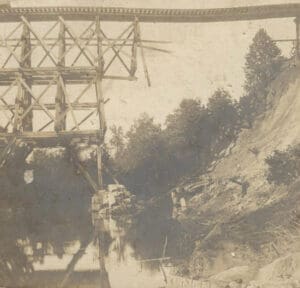
LaFoy had always loved the adventure of riding the rails, but lately, he had felt a dread when evaluating the safety of the aging Broadaway Creek Trestle. Maybe it was the rumors he’d heard that the trestle had been deemed unsafe…a rumor the railroad denied. And then last year, an engineer had been dismissed for voicing that he was afraid to cross the trestle in its condition. It was also said that wood-passer Henry Thompson intended to quit his job at the end of the month due to the rotten condition of the bridge, and a fellow conductor had even been heard saying that he felt they would all eventually die trying to cross the bridge.
LaFoy knew it was a dangerous night to be working the rails. In fact, his superintendent had advised the crew to stay overnight in Belton due to the weather conditions, but they had asked special permission to return to Anderson. The superintendent had granted permission but with these final words of caution… “Be careful. Watch your movements.”
These thoughts pushed and pried their way into LaFoy’s mind as he walked slowly through the dark rain toward the trestle for the second time that evening. His lantern swayed as he trudged through the mud as far as the ground would allow him to before it made an 80-foot descent down to the rushing waters of Broadaway Creek. The light shone dimly ahead of him as he stepped cautiously over the rail and began his dangerous trek along the row of wooden ties that led across the trestle.

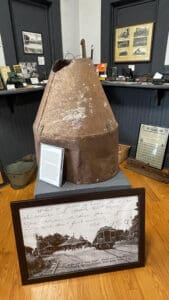
He remembered how proud his wife and children had been when he had been promoted to conductor 18 months ago. He had worked so hard the last ten years to make a new start for himself…to leave the horrors of the Civil War behind. His time spent in a Union prison in Knoxville had left a scar on his soul that it seemed nothing could erase. But the railroad was a place that usually kept those thoughts of war at bay…a place where he felt like he was finally accomplishing something important… a place where he was respected for his efficiency and his faithfulness to his job.
LaFoy walked about 100 foot out on the trestle and peered into the darkness, checking for stability issues or obvious compromises in the trestle’s safety. He didn’t notice anything different from the previous inspection earlier that evening. Afterall, the train had made the same journey only hours earlier. And this time their load would be much lighter since the passenger car had been left behind in Belton. He turned and headed back toward the train. If Wilson and Kitsinger agreed, they would continue on toward Anderson and all be home, safe and sound, in just a few hours’ time.
It was 3:30 am in the village of Anderson when the fire bells echoed through the quiet city streets. Immediately, hundreds of men began to assemble at the courthouse. Soon, the details of a horrific accident began to unfold. A woman who lived near the trestle had witnessed the glow of a lantern as the conductor made his routine check. Then she saw the train move onto the trestle. It had just cleared the bank when the timbers gave way, and with a deafening crash, the train fell to its doom. In horror, she had immediately spread the word. Neighbors had rushed to the scene and were anxiously awaiting additional help from town.
As the rain fell in torrents, every available man, horse, and wagon left Anderson and rushed to the scene of the accident to render aid. In the early light of morning, what met their eyes was much worse than any of them could have ever imagined. 100 feet of the 250-foot trestle had given way, and it appeared that the engine had turned a complete somersault during the 80-foot descent. The baggage car had been hurled with force into a pile of debris. There appeared to be but one survivor…the painful cries of Henry Thompson rose from the wreckage and filled the air. The men worked for hours to extract him from where he was pinned between the fallen timbers. After several hours, he was pulled to freedom and taken to a neighboring home where he died later that afternoon from his injuries.

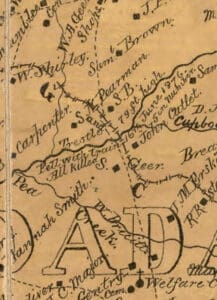
Conductor N. W. LaFoy and Kitsinger’s bodies were found further down the stream, carried there by the swift current. It was thought they were probably on the rear platform of the baggage car and tried to jump as the train fell but had become entangled in the falling timbers. They both lived in the vicinity of the accident, so their wives and children were present when their bodies were found.
The bodies of engineer Jack Wilson and fireman Allen Johnson were located beneath the engine and could not be removed until the proper equipment could be obtained to lift the heavy engine out of the way. The following morning, railroad employees arrived, and with the aid of 1200-1500 citizens working alongside them with ropes, they were able to overturn the monstrous engine. By late afternoon, both bodies were recovered.
A blanket of grief covered the entire community…such as had never been felt before. People traveled for miles to stare down into the deep chasm and mourn the lives of those killed that fateful night.
The railroad proceeded with a formal investigation. It was determined that the fallen trestle was caused by the washing away of earth due to the recent freshet and that the five railroad employees came to their death by misfortune or accident.
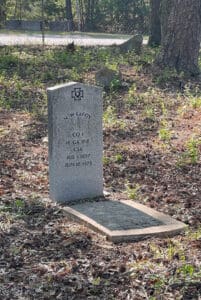
Conductor Newton Whitner LaFoy was laid to rest in the nearby Erskine Family Cemetery in Anderson, SC, on land belonging to his father-in-law. He was 38 years old. He was survived by a wife and 4 children.
Engineer John M, “Jack” Wilson was laid to rest at First Presbyterian Church Cemetery in Anderson, SC. He was 44 years old. He was survived by a wife and daughter.
Baggage Master Jefferson Kitsinger was laid to rest at Neals Creek Baptist Church in Anderson, SC. He was survived by a wife and 3 children.
Henry Thompson (wood-passer) and Allen Johnson (fireman) were laid to rest in Pendleton, SC.
Almost 150 years have passed since that tragic night. A trestle spans Broadway Creek, its stone pillars and beams visible from Amity Road during the winter months when the tree branches are bare. And a short distance away, cars drive down Belhaven Road past Vulcan Materials, never noticing what lies near the company sign…a little grove of pine trees surrounded by a chain link fence. And hidden in the shadows of those trees lies a few fieldstone grave markers and one lone tombstone bearing the name N. W. LaFoy. A soldier, a husband, a father…and a reminder of a tragic piece of Anderson’s history.
(Sources: The Anderson Intelligencer, The Abbeville Press and Banner, and Yorkville Enquirer)