


BY: Donna Andrews Bratcher
The name Andersonville often brings to mind the Civil War’s most infamous and deadly prison located in Andersonville, Georgia. But there was once another far less known Andersonville…a town which no longer exists. Located in upstate SC, at the confluence of the Tugaloo and Seneca Rivers, the settlement of Andersonville was a picturesque and prosperous river port established in 1801 by Colonel Elias Earle and named after Revolutionary War Hero, Robert Anderson. The town was positioned where the two rivers come together to form the Savannah River. It was a prime location during a time period when economic success depended greatly on water to power its mills and to transport products. Items such as cotton, animal skins, and wool were loaded on barges and sent downriver to Augusta and other large ports. At one time, Andersonville consisted of a several mills, factories, shops, livery stables, a large hotel, a post office, several stores, a number of residences and a female academy. Although the riverfront location of Andersonville was the leading factor in its success, unfortunately this would also lead to the town’s eventual demise.
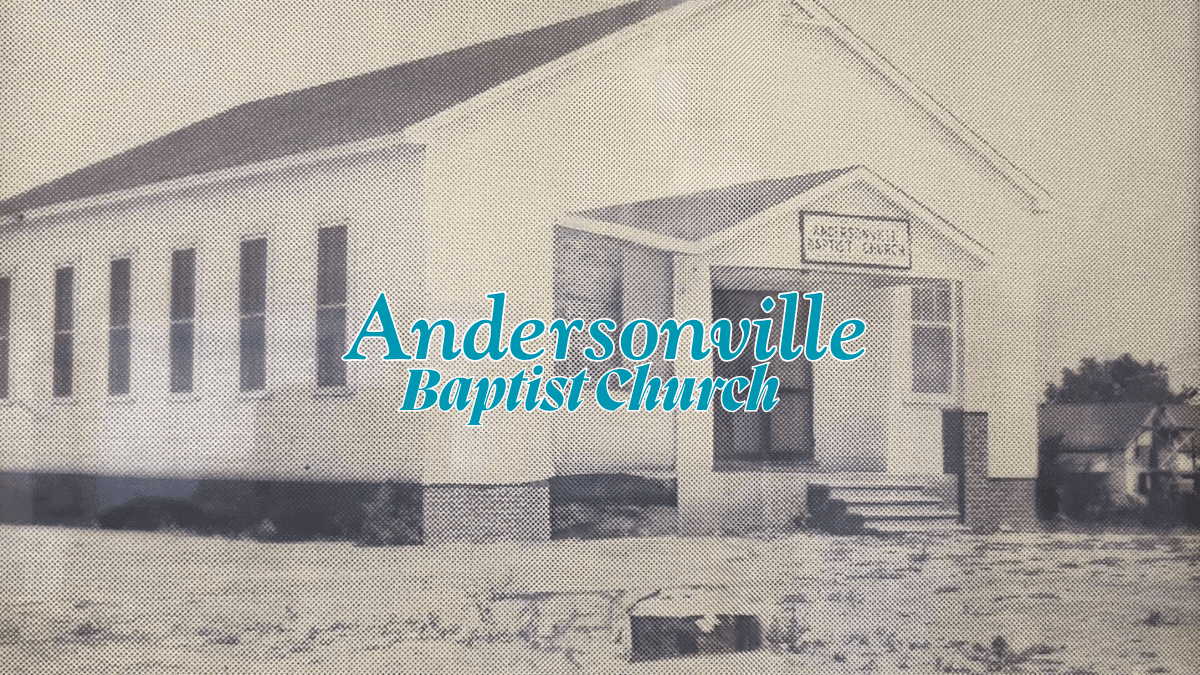
In 1839, 12 citizens of the town of Andersonville came together and constituted a new church. They named it The Baptist Church at Andersonville. The new church was built on the outskirts of town along the banks of the Tugaloo River. It was a simple white clapboard building in which timbers were put together using wooden pegs.
Because of the town’s position in the fork of the rivers, many church members and pastors accessed the church by ferry, traveling from both the SC side and the Georgia side. Due to the church’s location on the banks of the river, the building was subject to frequent flooding. A year after the church was established, torrential rain caused the Savannah River to flood its banks and much of the town of Andersonville was washed away. After the flood, the town and many of the businesses were rebuilt.
In 1852, the town of Andersonville was once again destroyed by flood. In addition to the second destruction of Andersonville, the town was also bypassed by the Columbia and Greenville railroad. A few years later, the Confederate War sealed the doom of the once thriving town. After the war, several attempts were made to revive the town, but none were successful. Although people continued to live in the surrounding area, and farm the fertile soil in the river bottoms of the Savannah, the town of Andersonville would never be rebuilt. Ten years later, the Andersonville Post Office closed, further isolating the community. Within a few decades, the streets of the once thriving town would be hidden beneath weeds, bushes, and the beautiful yet invasive Cherokee rose.
In spite of the failure of the town, Andersonville Baptist Church continued to stand strong for those who chose to remain in the surrounding area. Baptisms took place at the ferry on the banks of the Tugaloo. As the members were noted to say after a week-long revival meeting, “We have much to be thankful for in this vicinity. A good meeting, good crops, and good health.” In 1904, the church bought a parcel of land on a hill overlooking the river. This new location would remedy the problem of frequent flooding. The old church building was taken apart board by board, peg by peg, and rebuilt on the new property. It was often referred to as “the little white country church standing on the hill above the river.”
In 1955, the U.S. Army Corps of Engineers began construction of the Hartwell Dam. Over 2,000 people living in the reservoir area would be displaced from their homes and property. The site of Andersonville Baptist Church and the surrounding region would eventually be flooded. The church had faced many challenges through the years, and this would perhaps be the most serious of them all. In 1956, the church purchased 3 acres on Dobbins Bridge Rd. in Anderson County, SC. Also, the members voted to buy the brick sanctuary of Shirley Grove Pentecostal Holiness Church for $750.00. It was located a half mile down the road from their newly purchased parcel of land. The brick was removed from the church and the building was moved to its new location and covered in asbestos siding. This became Andersonville Baptist Church’s new sanctuary.
On October 14, 1956, after 117 years in the Andersonville area, members held their final service in the little white church that overlooked the river. The congregation took several items from the old church with them, including the original Bible lectern, beautifully handcrafted and held together with wooden pegs.
In addition to moving to a new place of worship, the church cemetery also had to be relocated. By 1962, when the Lake Hartwell reservoir reached full capacity, hundreds of graves had been relocated. Many of those were moved to the new Andersonville Baptist Church site. Graves from the former church site, as well as several local family cemeteries in the reservoir area, were interred in the cemetery adjoining the church. The graves are marked with names synonymous with the rich history of the community of Andersonville…Estes, Wright, Dyar, Smith, Earle, Stone, Liddell, Reeves, Moore, Maxwell, and many others…sadly, some graves bear no markers.
In the years that followed the move, the church continued to grow. A larger brick sanctuary was built in 1972 and continues to be the sanctuary in use today. The original smaller sanctuary still stands beside the new building…a reminder of the church’s humble beginnings.
For 186 years, through many changes and challenges, Andersonville Baptist Church has stood strong. As a former preacher once said, “Even the floods of Andersonville Island could not destroy the church of Andersonville. The only thing left of the town of Andersonville is Andersonville Baptist Church. When all the destructive forces of man and nature tried to destroy Andersonville, it just moved to higher ground.” And there it still stands today.
“…and the rain descended, and floods came, and the winds blew and beat on that house, and it did not fall, for it was founded on the rock.” Matthew 7:25